
The Tip of the Iceberg
A Return to Focal Practices


Post 4: The Tip of the Iceberg
In the first few posts, we’ve explored how artificial intelligence is reshaping engineering education, vocation, and formation. But AI is just the tip of the iceberg. Beneath it lies the entire digital age—smartphones, social media, dopamine loops, curated selves. AI didn’t create this world. But it’s accelerating it. And if we want to form students who can thrive in it, we have to address the whole iceberg.
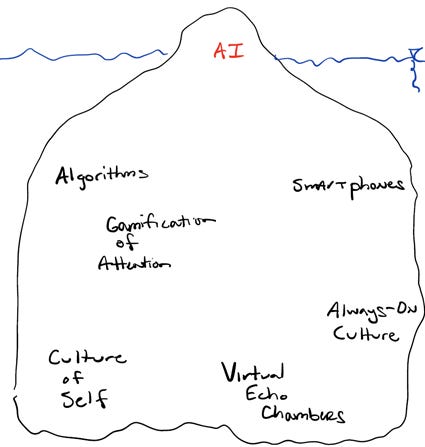
AI as the Tip of the Iceberg
This is where the t-shaped engineer comes back into view.
In my book, The t-shaped Engineer in the Age of AI, I describe a model of formation that integrates technical depth, relational breadth, and theological grounding. It’s shaped like a lowercase “t”—a cross. And that shape matters.
Because in a world of acceleration, distraction, and disconnection, we need engineers who are not just technically competent, but relationally wise and spiritually grounded. We need formation that is slow, communal, and intentional.
And that brings me to a story—because that’s how I promised we’d explore these ideas here: through narrative, through lived experience, through moments that shape us.
The Hearth and the Heat
Two months ago, I was selected to attend a Christian retreat on discipleship in the digital age. Over 80 people at our university applied—only 20 were chosen. I was honored to be among them.
The retreat was led by Jonathan Lett, my coauthor on the first paper introducing the t-shaped engineer. Jonathan is a theologian—brilliant, thoughtful, sometimes lofty in language. But not here. At this retreat, he was grounded, relatable, vulnerable. A gifted facilitator. He curated an amazing experience.
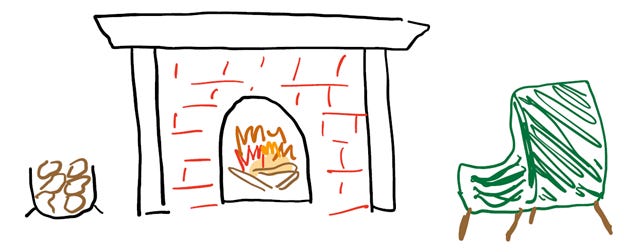
We explored how the digital world is shaping us—how it forms our habits, our attention, even our desires. One metaphor in particular stayed with me: the hearth.
In pre-modern homes, the hearth was the focal point—the source of warmth, light, and life. But it took effort. You had to gather wood, tend the fire, keep it going. It was a communal task. A focal practice. And that was the point: some things aren’t meant to be rushed. They’re meant to be done slowly, together, with care.
That image broke something open in me.
We talked about the good things the digital age offers—but also the ways it tempts us to trade depth for speed, presence for performance. In particular, what a precious resource and gift our attention is. These are themes and implications I explore more fully in my book: the erosion of attention, the rise of anxiety, the epidemic of disconnection. The digital world isn’t neutral—it’s forming us.
We talked about being dedicated children of God in the current moment. After several days of marinating in these ideas, something shifted. That experience led to my preparing a workshop to train our faculty how to do this whole thing better. While prepping for that workshop, I realized I had the bones of a great conference talk.
Then I realized I had something more:
Something important to say.
I wrote an abstract for a conference at Baylor University.
Then a paper for submission to a respected journal. I had caught the fire – I tended it, which led to the book – The t-shaped Engineer in the Age of AI.
The abstract, the journal article, the book—they all poured out of me, but only after a period of quiet reflection.
This retreat didn’t just inform me. It re-formed me.
It reminded me that formation is slow. Communal. Intentional. And that in a world of acceleration, the hearth still matters.
In the next post, I’ll return to the classroom—to explore how we’re helping students wrestle with these questions in real time.
But for now, let me leave you with two questions:
1. Where have you traded depth for speed in your own life?
2. What would it look like to tend the hearth again—to slow down, be present, and form together?
That idea of focal practices from Albert Borgmann has really shaped me too. A few other posts worth sharing on that idea (wouldn't be surprised if Jonathan already shared these with you...)
Andy Crouch: https://andy-crouch.com/articles/rekindling_old_fires
Alan Jacobs: https://blog.ayjay.org/the-year-of-focal-practices/